Common Clay / The table collection
A bowl.
A daily ritual.
Open forms, quiet glazes and an edge that feels right in the hand. Studies for the everyday table, from clay body to finished surface.
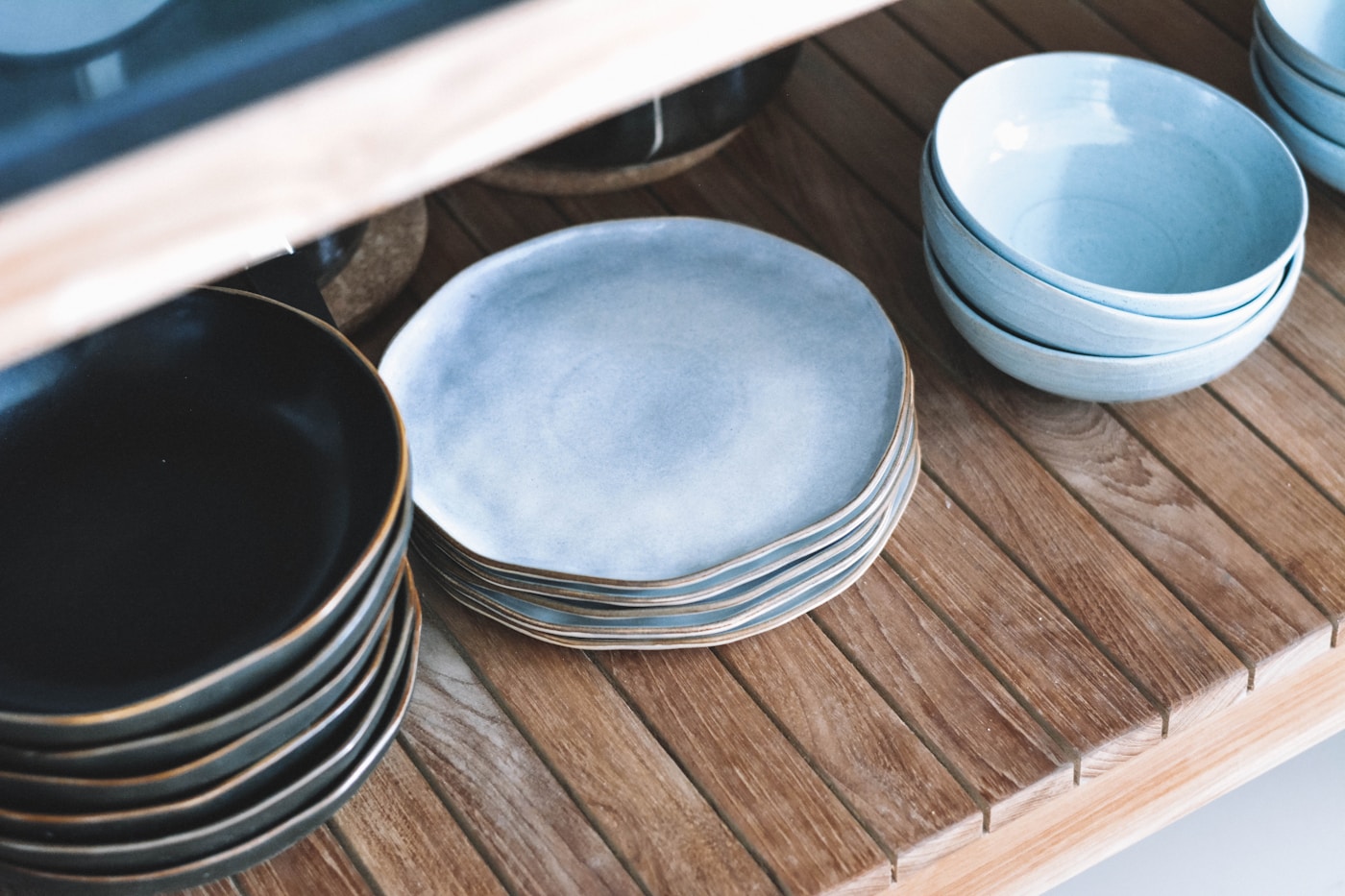
Forms for the table
A small family of useful shapes.
| Object | Study notes |
|---|---|
| Low bowl | An open curve, a quiet foot, room for a spoon |
| Everyday plate | A shallow well and a rim that lifts easily |
| Straight cup | A steady base and an unhurried handle |
| Pouring vessel | A narrow lip and a clear direction of flow |
The surface is part of the form.
A pale, quiet ground
A chalk-toned glaze lets the edge of a vessel do the talking. Test it in daylight and warm interior light; a neutral surface is rarely as colourless as it first appears.
Warmth from the body
Iron-rich colour brings the clay body into the conversation. Keep a record of the firing schedule and the thickness of each test, rather than attributing every variation to chance.
A cooler pool of colour
A blue-grey glaze gathers differently at a foot and a rim. The reference photograph shows how related tones can make a group feel like a family without making every piece identical.
From a lump to a familiar object
-
1
Throw for the hand
Test the opening and the lift while the form is still easy to change. A silhouette alone cannot tell you how a bowl feels.
-
2
Trim for the table
Let the clay firm before cutting the foot. Check that the base settles without rocking and leaves enough material to support the wall.
-
3
Keep the test beside the result
Label the clay, glaze and firing record. A beautiful surface is useful knowledge only when its conditions can be found again.
Keep everyday care uncomplicated.
Can a glaze photograph prove a piece is food-safe?
No. Food-contact suitability depends on the materials, firing and appropriate testing. The object studies here make no food-safety or appliance-safety certification claim.
How should an unfamiliar ceramic piece be handled?
Avoid sudden temperature changes. Wash gently and dry before storing. Follow the actual maker's care instructions rather than assuming every ceramic body behaves alike.
Not an object for an occasion.
An object that makes an occasion.